Lake Wylie Waterfront Sales: Mid-year Review 2026
Want to receive Lake Wylie real estate updates monthly by email? Call or send me an email and we'll get you set up.
We’ve been tracking sales for dockable waterfront homes and lots for nineteen years — “cleaning up” the data to eliminate occasional coding errors and making sure we’re looking at true waterfront properties. My team and I closely monitor prices, sales and influencing factors to help you understand the Lake Wylie real estate market like no one else can, as well as to hone our own expertise to ensure we’re giving you the best advice possible.
Mid-year 2026 snapshot
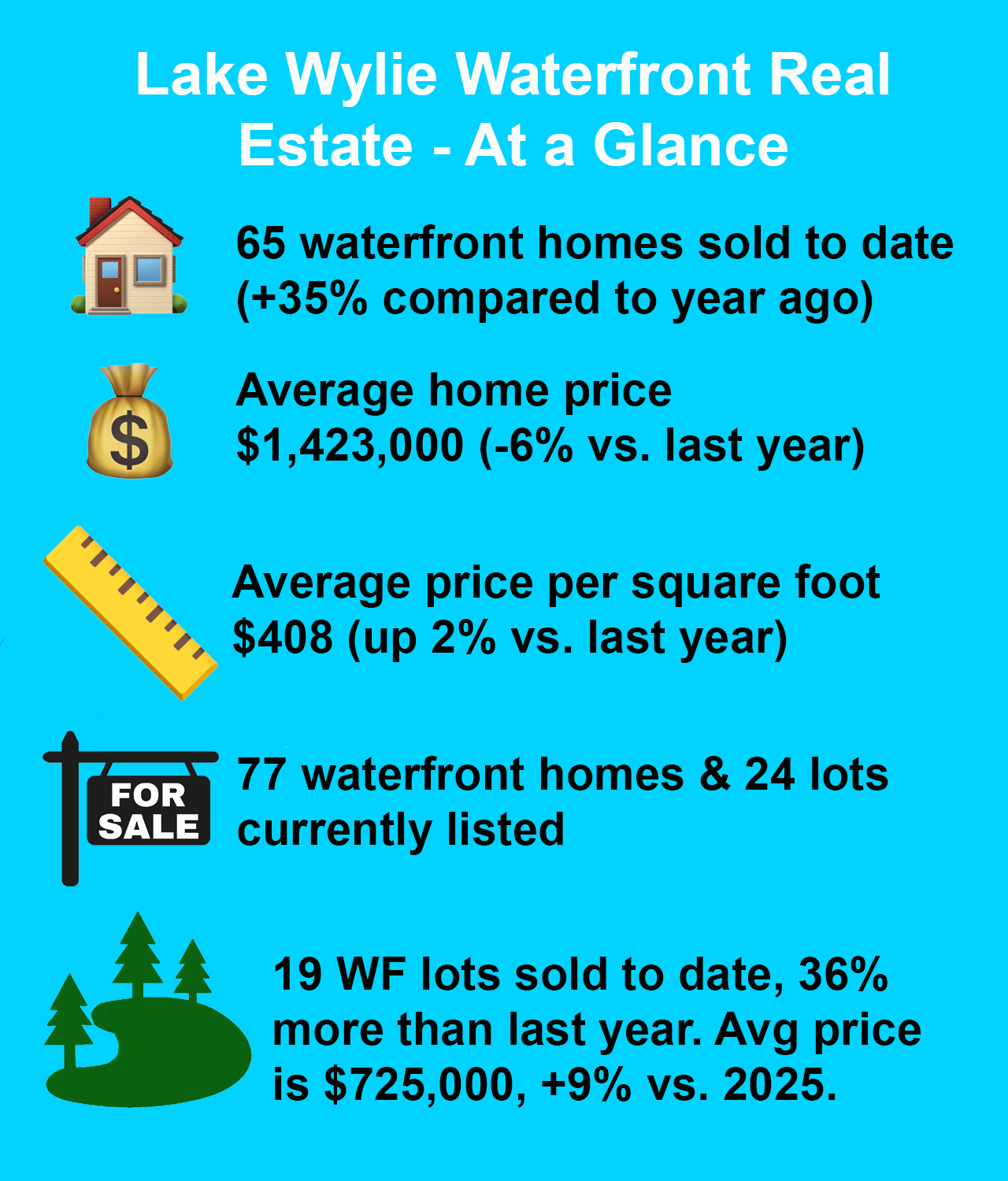
We're halfway through 2026, and while waterfront sales are tracking higher than the past three years, we're entering a more balanced market overall.
Prices are holding steady, the average time on market is stretching out, and sellers are negotiating more off of their original asking prices.
Strong sales in the first half of 2026
At the end of second quarater this year, 65 dockable waterfront homes and 19 lots sold. Each are up 36% in comparison to last year during the same period.
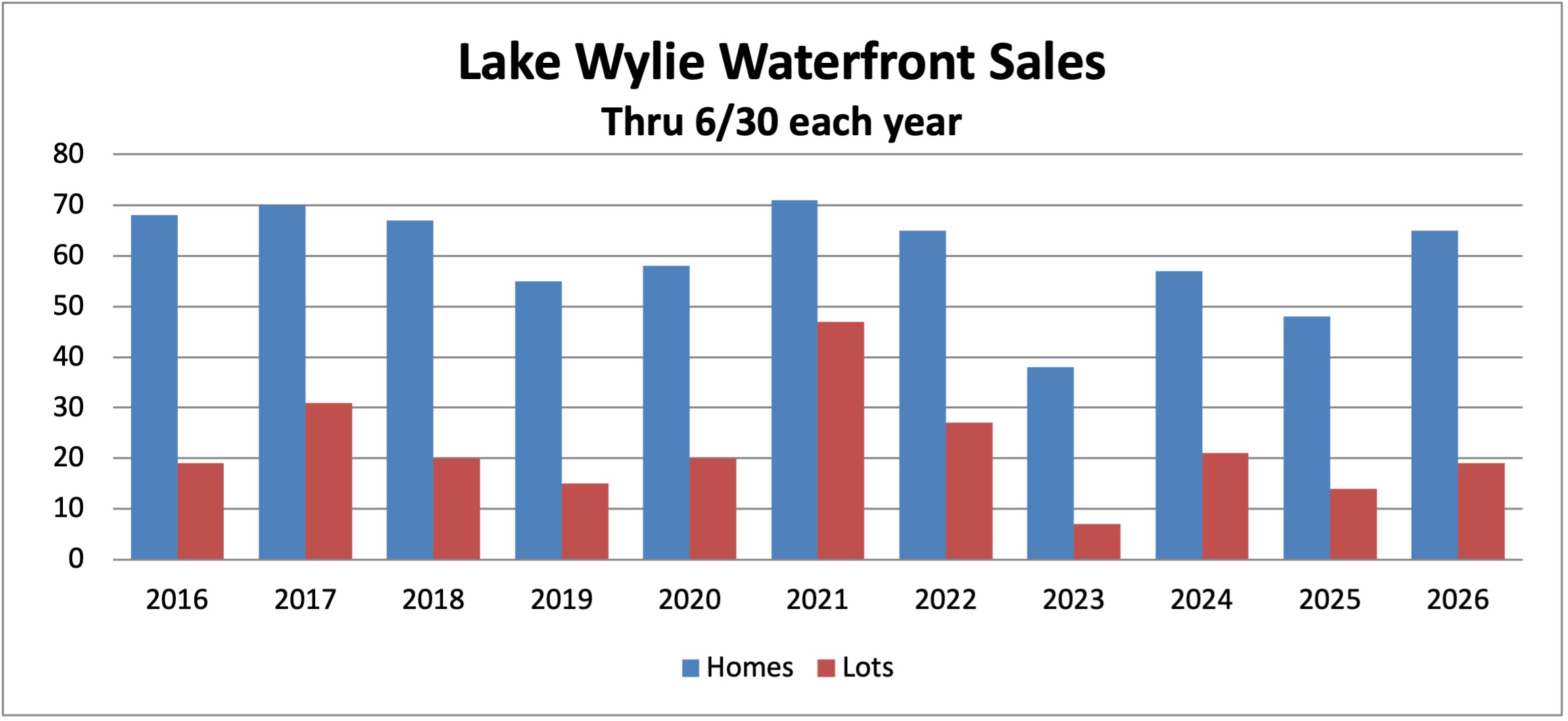
In the chart above, the blue bars represent the number of dockable waterfront homes that closed during the first half each year, and the red bars represent lots. Both types of waterfront properties show impressive gains in comparison to last year.
Dollar sales for waterfront homes on Lake Wylie during the first six months of 2026 are the highest ever: a total of $92.5 million, shattering the previous record for January - June with $80.2 million in 2024. In addition, total sales for dockable waterfront lots reached $13.8 million, second only to the $16.4 million sales total in first half of 2021, when 47 lots sold during that period.
Typically, sales begin climbing in late spring and peak in the late summer. This year, however, the strength of the market was earlier:
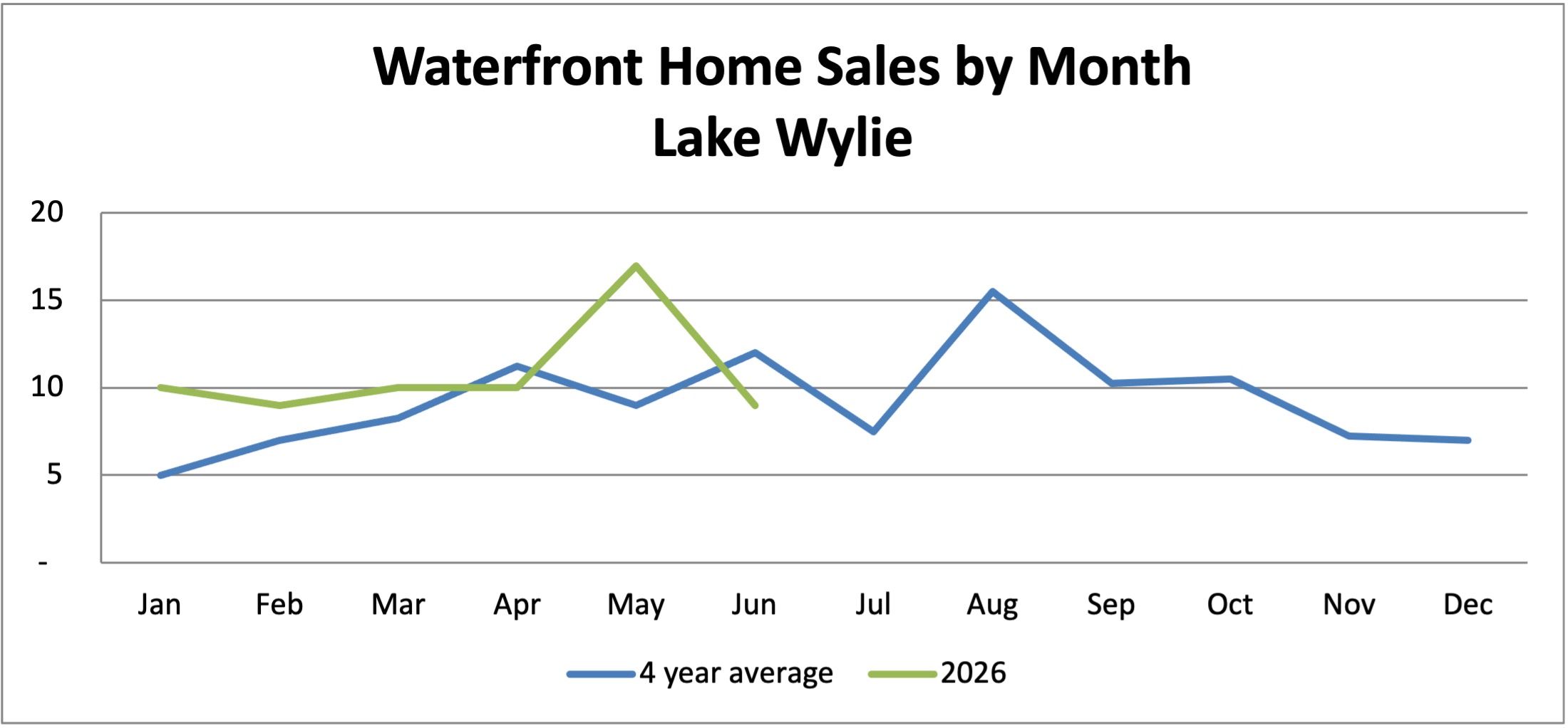
In the chart above, the blue line represents the number of dockable waterfront homes closed on Lake Wylie by month, averaged over the past four years. Typically, closings begin building in spring and peak in late summer before tapering off at the end of the year. However, the market is active all year — unlike markets with greater "tourist" or seasonal influx, or extreme winter weather. Some weather events — such as prolonged summer droughts — can impact lake real estate, as we have seen in years past.
This year, January sales broke records and activity held steady through the spring, with a noticeable peak in May. Severe drought conditions slowed the market momentum, however, resulting in a dip in inventory as some sellers took their homes off the market, waiting for lake levels to return to a more favorable state.
Economic uncertainty and high mortgage interest rates has also played a role in declining market activity the past couple of months. Nationwide, the real estate market is softening into a more balanced role between buyers and sellers. Sales on the West Coast and in the Sun Belt (lower half of the U.S.) are experiencing higher inventory levels and relatively flat pricing, with longer time on the market.
Market performance in other parts of the country affects sales in our area, as some out-of-town buyers need to sell their homes prior to purchasing on Lake Wylie.
Charlotte has a relatively high number of homes currently on the market, and while job growth and migration into the area remain strong, homes are taking a bit more time to sell, and buyers are able to negotiate more with the sellers.
In contrast to a few years ago when average prices were climbing steeply, the past six months have shown prices to hold steady:
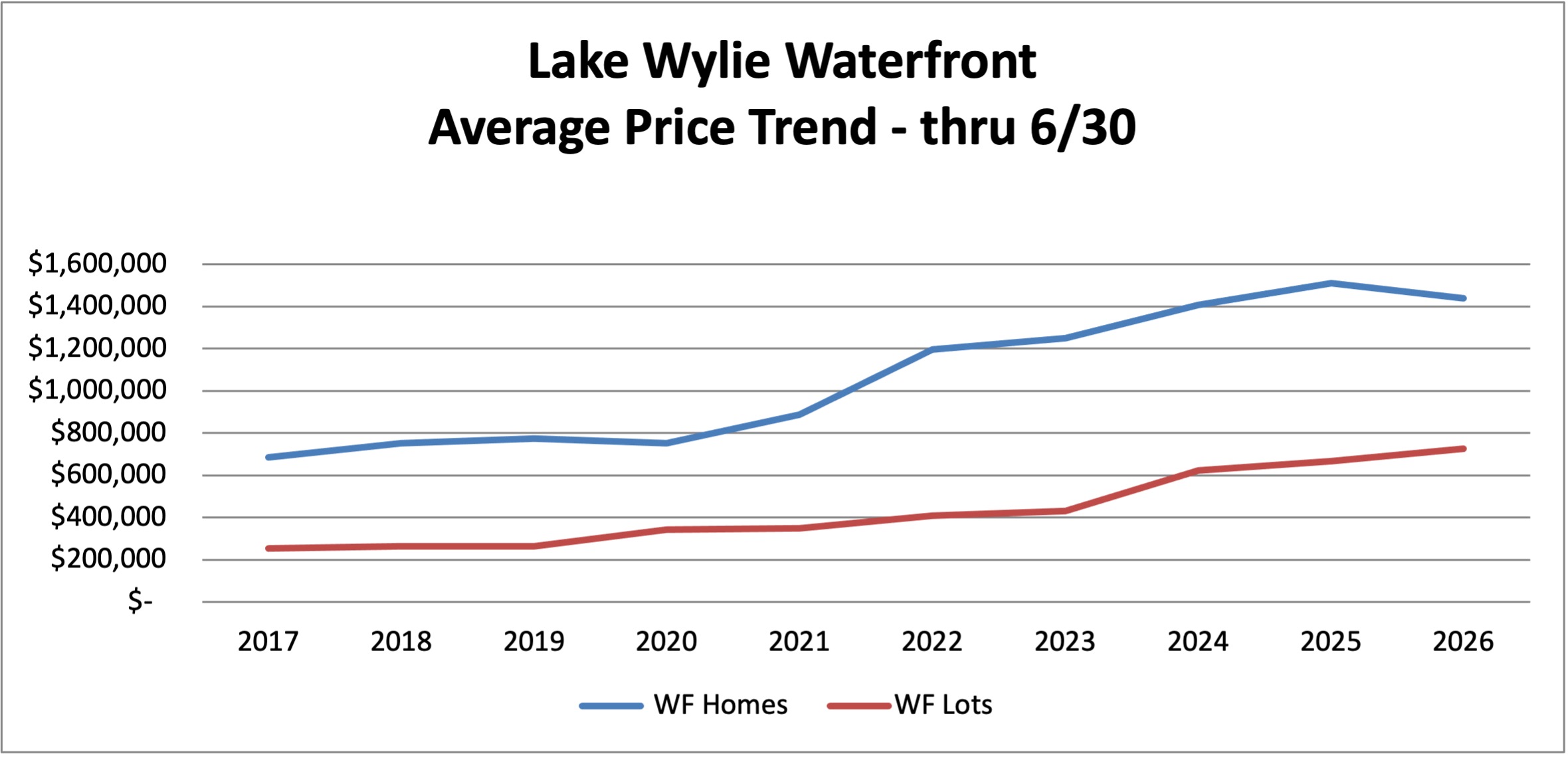
The blue line in the chart above represents the average closing price for waterfront homes each year, and the red line represents average lot price.
After steadily climbing year to year, the average price paid for waterfront homes in January-June of 2026 took a surprising turn — posting a 6% drop compared to the previous year. HOWEVER, there is more to the data than meets the eye.
Sixteen waterfront homes sold thus far in 2026 can be classified as "river cabins" — structures originally built as weekend getaways. Quite a few of these were built when the land was owned by Duke Energy and leased to the occupants, rather than sold. Since the lessees did not own the land, they constructed small cabins with relatively low cost materials, simple shelters to meet their needs while enjoying the lake. Some of these structures still exist around the lake, and many have been expanded or renovated as the occupants were able to purchase the land.
These "river cabins" usually have about 2 bedrooms, less than 1400 square feet, and were built 40+ years ago. Some are located on premium lots with wide open views, and are still enjoyed as second homes.
Over the past five years, an average of 16 cabins have sold each year — so this year's activity is much higher than usual. The proportion of sales for cabins has lowered the overall "average" price for waterfront homes this year. Taking the cabins out of consideration, however, we see the average sales price for a lakefront home is about $1,575,000 — a 1% increase over the average price for similar homes last year.
Lot prices continue to rise, now averaging $725,000 for a dockable homesite. This is a 9% jump from last year.
Waterfront prices vs. Off the Lake
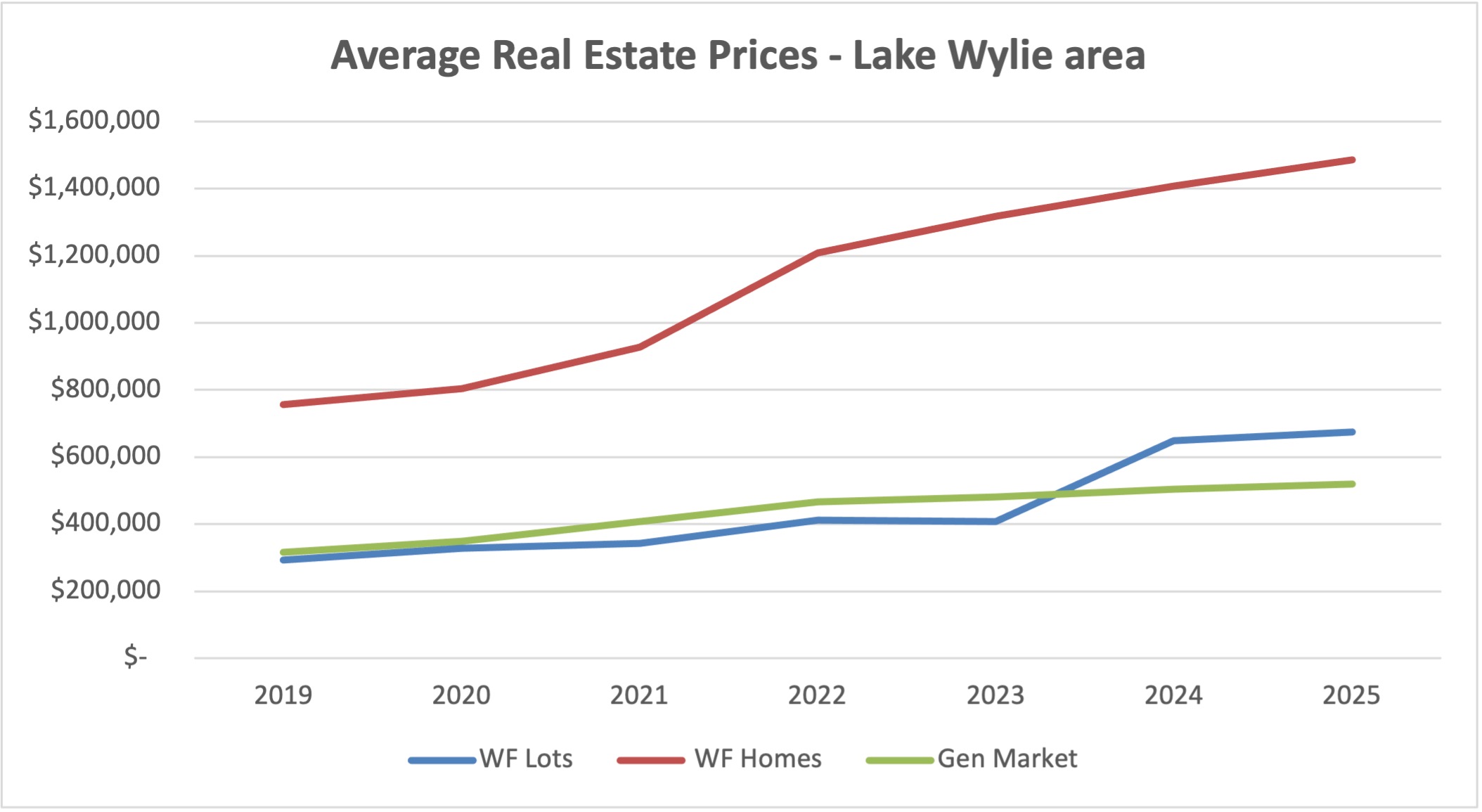
In the chart above, the red line represents the average price of Lake Wylie waterfront homes sold each year. The blue line represents the average sales price of dockable waterfront lots, and the green line represents average home prices for non-waterfront homes in the six-zip-code Lake Wylie area.
Since 2019, waterfront home prices have increased 96%, lot prices have jumped 131%, and non-waterfront home prices are up 64%. The average price of an undeveloped waterfront lot now surpasses that of the average “general market” (non-waterfront) home.
The average price of a waterfront home on Lake Wylie is approaching $1.5 million, and a non-waterfront home in the same area averages $520,000.
Comparing the average prices for waterfront vs. non-waterfront, we could say in 2019, buyers paid an average premium of $450,000 for a waterfront home. Currently, the premium is almost $1 million. That jump has priced many buyers out of the market for waterfront property.
What does your money buy on the lake?
Off the water, home prices depend on a number of factors: the neighborhood/ location, the size of the home, the age/condition, the level of finish (quality and type/style of materials), and other enhancements (pools, outdoor living spaces, landscaping, etc.).
For waterfront property, all of those factors — plus several unique to lake homes — determine the market value. The type of view (long range water views vs. a narrow cove, for instance), the shore enhancements (size and quality of dock, rip rap and shore stabilization), surrounding properties, flexibility of use for the lot, water depth and clarity all contribute to the price buyers will pay.
Supply and demand play a role as well. Based on current listings, buyers can expect the following types of waterfront homes on Lake Wylie by price range:
Under $1 million - 3 bedroom home, 2250 square feet, 2-3 baths, an average of 47 years old. Some of these properties are “cabins”, originally designed for weekend use, with renovated properties selling for higher prices.
$1-$1.5 million - 4 bedroom/3 bath home, average of 2900 square feet, 31 years old.
$1.5-$2 million - 4 bedroom/5 bath home, average 4250 square feet, about 25 years old.
$2-$3 million - 5 bedroom/6 bath home, average 5900 square feet, 13 years old. Many have pools or outdoor living areas.
Over $3 million - 5 bedroom/6 bath, average 6300 square feet, most under 5 years old, ultra high finish levels with luxury pools and outdoor spaces.
Negotiating Trends
OThe "bidding war" days are coming to an end — at least for the moment. The average sales price so far in 2026 is 94% of the original asking price, which was the "norm" pre-pandemic. Homes that are overpriced when first listed are taking the deepest cuts — and the longest time to sell.
|